Marilyn Perry On Discovering Andrew Imbrie's Musical Work Dandelion Wine
Discovering Andrew Imbrie's Musical Work Dandelion Wine

Marilyn Perry, John O'Hara
Upon First Encountering Andrew Imbrie
I first heard Andrew Imbrie’s music during a period of time in my life when I was studying music composition with one of his students, David Del Tredici. David Del Tredici is a master composer in his own right. In 1982 David Del Tredici was awarded the Pulitzer Prize in music. During his lifetime, Andrew Imbrie was nominated for the Pulitzer Prize in music, but was inexplicably never awarded renowned accolade.
Early one Sunday morning, after I had stayed up all night studying and composing at my desk, I took a break to soothe my senses. At the time, my musical explorations had evolved beyond music such as the Second Viennese School: Arnold Schoenberg, Anton Webern, and Alban Berg; toward composers such as George Rochberg, Charles Wourinen, and the other abstract expressionist serial technique composers who were composing music in that style during the late 1960s and early 1970s.
It was my intention that morning, during that wee hour, to hear George Rochberg’s early Piano Trio, the one he wrote in the mid-sixties. As I scanned the album cover, the words Dandelion Wine caught my eye. The phrase Dandelion Wine was familiar. Those words are the title of a short story by the late author Ray Bradbury, a high school reading fancy of mine. Unable to resist, I listened to the musical piece Dandelion Wine instead of the Rochberg Trio. Andrew Imbrie’s Dandelion Wine was short. It was a less than five minute cut on the vinyl record, by a composer whose music and whose name I had not noticed before. I thought it couldn’t waste much of my time, so why not.
Those four minutes changed my music composition life forever.
How Listening To Dandelion Wine Transpired
As I listened to Andrew Imbrie’s Dandelion Wine, my ears were engulfed by what I heard. My exhausted senses were transported to a unparalleled plane of ecstasy as I listened to Dandelion Wine for the first time! The music beckoned me in. The music's ensemble consisted of Oboe and Clarinet, String Quartet, and Piano. After Dandelion Wine's opening, which was announced by a repeated note motif on the piano, that repeated the note A5 four times in sixteenth notes, offset by tremolo strings playing a sonority that implied a B-flat ninth chord, the lament of an oboe launched into a faun like, nostalgic, lyric melody. When the oboe passage subsided, a high, intense violin theme then drove the music toward its first emotional apogee.
That opening section of the work Dandelion Wine was followed by a developmental exchange of short melodic bursts, bursts that echoed and answered between the various parts of the small chamber ensemble.  The music then built to a huge climax that was dominated by runs of rising woodwind quintuplets interspersed with repeated note chords on the piano that recalled the opening motif, and pizzicato string accents, reminiscent of jazz improvisation. At the music's climax, the oboe and clarinet fluttered downward from a high register, releasing all the musical tension and energy with a cadenza like flurry that faded into repose.
A recapitulation followed the high climax, as the oboe punctuated the repeated note theme announced by the piano at the beginning of the work to begin its recapitulation. A compressed version of the work's exposition followed, with the violin and clarinet taking turns with soaring thematic lines. At the end, the piano recalled the opening repeated note motif once more, and brought the brief but exhilarating experience to its conclusion. The music dispersed with one last recollection of the repeated notes from the piano and a sonorous ponticello tremolo version of the opening sonority from the strings.
I listened to Dandelion Wine over and over again that morning. Its form was clear and immediately audible from my very first hearing of it. It transitioned from one instrument to another in a traditional way, each instrument taking a turn at the melodic lead, carving out each successive musical stanza. The entire piece was highly chromatic in one sense, but its sonorities felt grounded in tonal implication in another. The sonorities were complex, but at the same time they implied triadic, somewhat jazz like chords. This brief, nearly microcosmic, musical work encompassed everything I knew at the time about chromaticism, but with a personal, optimistic quality lacking in much of the music written during that era.
Despite its clarity, it had a subtle, unexpected flexibility that acknowledged tradition but didn’t sound traditional. Those four short minutes introduced me to a musical aesthetic that I had unconsciously known might exist, but hadn’t previously been able to find or imagine. Andrew Imbrie's musical work Dandelion Wine embraced everything I had heard and enjoyed from chamber music written in the past, while instead being a fresh, immediate harbinger of the future. It changed my music compositional outlook forever.
Dandelion Wine was written in the summer of 1967. It sounded as fresh and new when I listened to it again recently as it had the first time I heard it so many years ago. After that first hearing, I sought more of Andrew Imbrie’s music, found it, enjoyed it immensely, and set out to learn everything possible about how he had constructed it.
Revelation - Changed Forever
That first exposure to Andrew Imbrie’s music cemented in my mind and in my compositional values, that composing at its best is about individual, personal, emotional, expression. In Andrew Imbrie’s own notes for the CRI recording of his Symphony No.3 and his Sonata for ‘Cello and Piano he wrote:
Describing one’s own music is a little like describing one’s voice and manner. It is easier to say what it is not than to say what it is. ... It [ his music ] is neither experimental nor conventional. I always start at the beginning, and let the ideas shape themselves as they must; the direction they will pursue and the changes in character they will undergo become increasingly clear as I go on. I find that an initial musical statement, once made, raises obligations that the composer must have the wit to recognize and to fulfill. ... In making the judgments that lead to all this, the composer must constantly resort to innovation-yet he is influenced by the other music that he loves, both old and new. Without such participation he would be powerless. Originality, if indeed present at all, is the style with which the composer characteristically chooses, weighs, shapes, and distorts. It is to be found not in his polemics, but in his voice and manner.
All the music by Andrew Imbrie that I have heard since, confirms for me that he has internalized, and made his own, through his music, the values he describes so well in the passage above.
KPFA Live Conversation With Andrew Imbrie (1971) On His Work Dandelion Wine for Chamber Ensemble
On the occasion of Andrew Imbrie's fiftieth birthday, April 6, 1971, KPFA Radio in Berkeley, California invited Andrew Imbrie to a live on-air discussion of his music, with performances of several of his extraordinary musical works. The second audio selection above is an edited version of that 1971 live radio event. After editing the original recording to include only portions of it that focus on Andrew Imbrie's composition Dandelion Wine, and on Andrew Imbrie's conversational discussion of his music and of composing, the audio recording remains about fifty-three (53) minutes long. This listening treasure was a discovery happened upon a few years ago when it was among some internet search results for information related to Andrew Imbrie and his musical compositions.
Recordings of Andrew Imbrie's Dandelion Wine for Chamber Ensemble
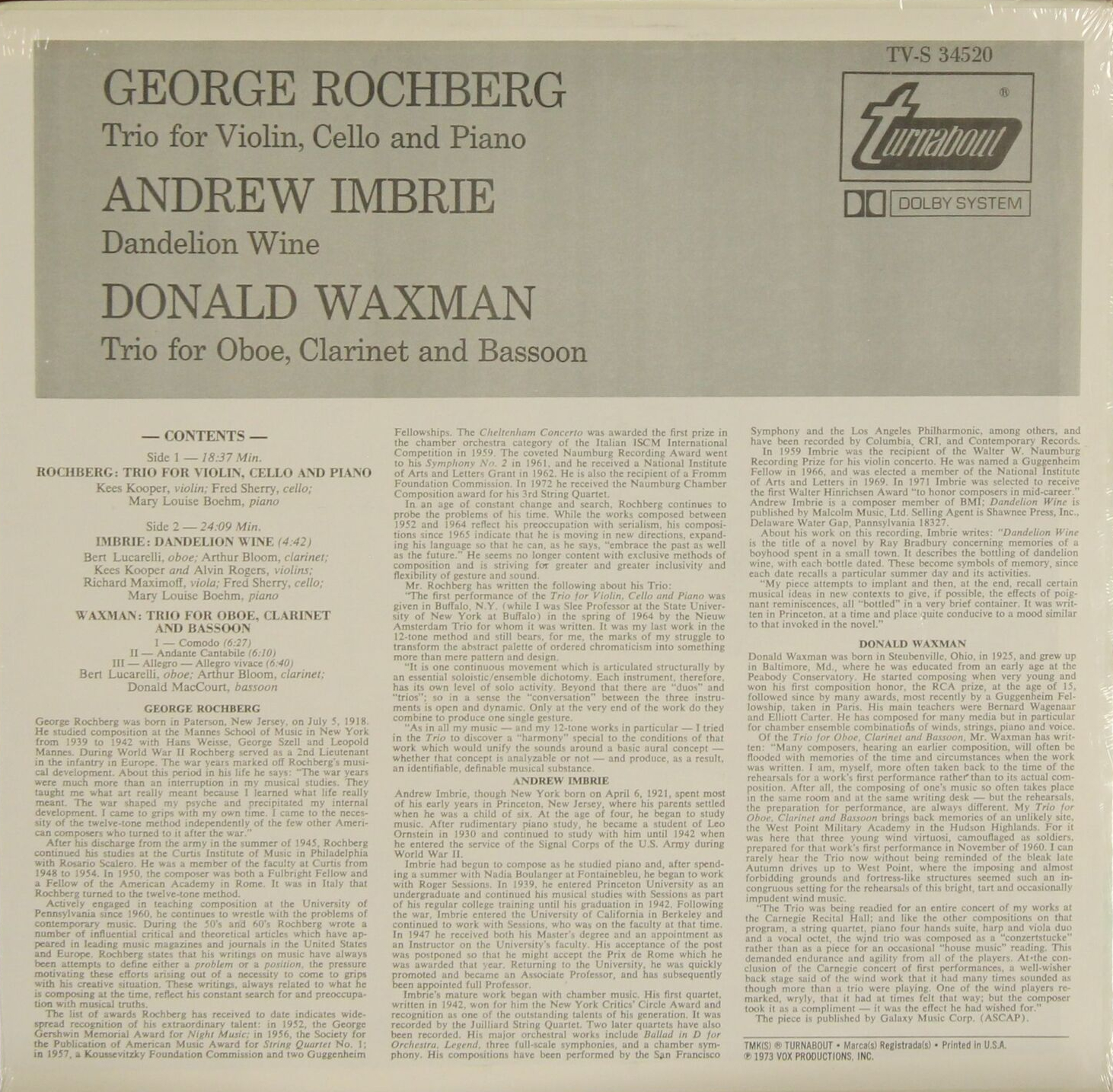
Andrew Imbrie's work for chamber ensemble, Dandelion Wine, has been recorded twice since he completed it. The first recording of Andrew Imbrie's Dandelion Wine was released by Turnabout Records (VOX) on a vinyl album in 1973 along with works by several other composers. The Turnabout Records performance of Andrew Imbrie's Dandelion Wine is performed by:
- Cello – Fred Sherry
- Clarinet – Arthur Bloom
- Oboe – Bert Lucarelli
- Piano – Mary Louise Boehm
- Viola – Richard Maximoff
- Violins – Alvin Rogers, Kees Kooper
It seems best to infer that the 1973 Turnabout Records performance is the definitive interpretation of Andrew Imbrie's Dandelion Wine. Although the 1973 recording on vinyl is long out of print, the version of it provided here for listening is the 1973 Turnabout Records version, digitized from an original vinyl record, vinyl pops, scratches, and all.
Turnabout Records 34520
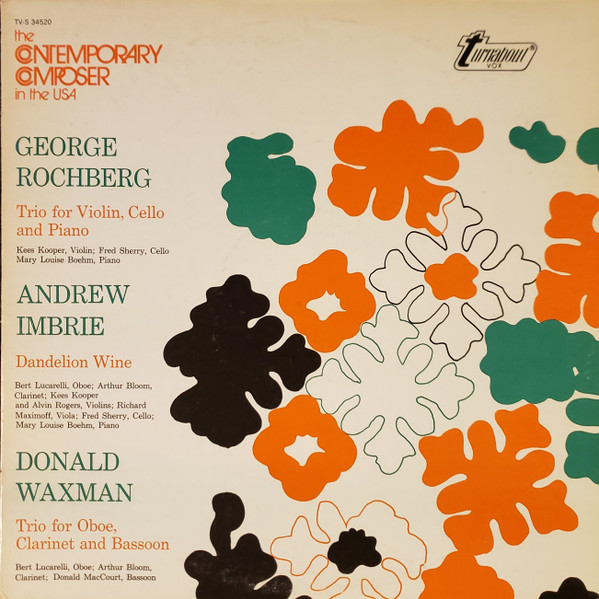
Turnabout Records 34520
Bridge Records 9271 (A/D)

The second recording of Andrew Imbrie's Dandelion Wine is more recent. In 2008 Bridge Records recording of Andrew Imbrie's Dandelion Wine is part of a large collection of music written by American composers who had studied composition in Rome, Italy many years ago. Despite the fact that the 2008 recording was created with current digital technology, as a listening experience, 1973 remains definitive.
Thank you for visiting this website, my personal website, and hopefully your enjoyment the information and content shared here publicly at www.marilynperry.com. Marilyn Perry | Sunday, March 2, 2025