Marilyn Perry on Allen Forte’s 4z29 and 4z15 "All Interval" Tetrachord Nomenclature
Allen Forte’s 4z29 and 4z15 "All Interval" Tetrachord Nomenclature

wallpaperscraft.com
During a conversation recently, it became apparent that it seems as though few people ever ask about using 4z29 and fourztwentynine as monikers. The quite intelligent conversationalist in the conversation immediately asked what 4z29 means.
Somehow, in the complexities of our verbal discourse, I never answered the question! I wonder if that quite polite person knew that I was quite conscious of not having answered the question but that I had tacitly decided to delay my answer for later. Although I didn't directly answer the question, I noted that the answer was extraordinarily obscure, profoundly nerdy, and probably completely boring for all but a rare few people.
Among my primary collegiate educational interests was - symphonic music theory - and specifically the related - combinatorial calculus - a subset of mathematics that precisely describes certain pitch relationships in western - equal pitch temperament - music. Analytic Combinatorics is the mathematics of certain types of discrete structures, such as the scope of relationships between the twelve pitches, tones, notes, that comprise western cultural equal temperament music.
In 1964, a music theorist named Allen Forte, who was a mathematics and music theory professor at Yale University, published a scholarly journal article entitled:
"A Theory of Set-Complexes for Music"
for the academic periodical "Journal of Music Theory". In Allen Forte's journal article, and in a 1973 book Forte later wrote, Forte codified all the possible relationships of unordered, and ordered, sets (i.e. groups), of musical pitches (tone/notes) that can be derived from the twelve (12) available/possible pitches. These sets are called “pitch class sets”. Look at a piano keyboard sometime to see that there are twelve notes/pitches in each octave. The nomenclature of each of these pitch class sets is appropriately designate Forte Numbers.
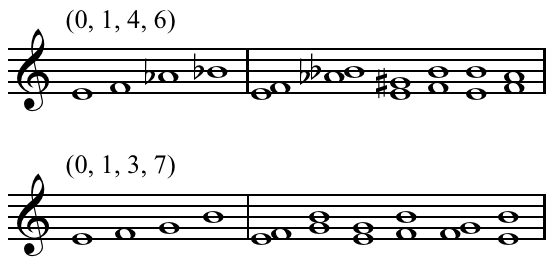
Allen Forte noted that there are two and only two combinations of four (4) pitches, from which it is possible to derive every possible two note (pitch) pairs. Allen Forte decided to name these pitch sets "all interval" sets. In Allen Forte's pitch class set classification system he gave these "all interval" sets the designation - Z - to communicate that they exhibit this - amazing - property.
It seems likely that for most people, such a moniker as - 4z29 – which is music theorist Allen Forte's name for this extraordinary “pitch class set”, which is one configuration, of just two four (4) musical note (pitches) sets that possess this extraordinary "all interval" property, which also happens to be the 29th four (4) pitch group (set) in his list of 4 note musical pitch groups. Thus 4z29 means a set (group) of four (4) musical pitches (notes/tones), which is 29th in Allen Forte’s overall derivation of 4 note sets (unordered groups), and for which the Z indicates that any and every possible 2 note/pitch interval pair can be derived from pairs of notes/pitches within it. This type of pitch class set is an "all interval tetrachord". There are only two all interval tetrachord pitch class sets, the 4-Z29 and the 4-Z15 sets.
We live in a culture these days when so few people listen to symphonic music, or know much of anything about symphonic music, or symphonic music theory for that matter, that everything about this tidbit of information is, as far as may be imaginable, obscure beyond reckoning for most people.
Thank you for visiting this website, my personal website, and hopefully your enjoyment the information and content shared here publicly at www.marilynperry.com. Marilyn Perry | Tuesday, February 17, 2026