Marilyn Perry's Notes On the Pi-Hole Network Wide Ad-Blocking Software Application

Pi-Hole Network Wide Ad-Blocking Software System
pi-hole website screenshot
In the worldwide war against World Wide Web advertisers, from Google and doubleclick.net, to the thousands of other internet advertising syndication agencies, the open-source local area network (LAN) wide ad-blocking computer software application called Pi-Hole is the state-of-the-art defense system for combating the ever-growing onslaught that is internet advertising.
Internet advertising is more than an annoyance. Internet advertising is a security risk. Internet advertising, and the agencies that purvey it, are also a constant threat to the right to personal privacy. Worse yet, internet advertising has even been used as a delivery agent to deploy malicious and destructive computer software viruses, including ransomware.
The current answer to the broad spectrum computerized threat that is internet advertising is the open-source software program called pi-hole. The pi-hole software program blocks advertising at the local area network (LAN) level. The open-source, community developed and maintained, pi-hole software application blocks internet advertising by firewalling a local area network at its domain name service (DNS) level. As of writing these notes about pi-hole, the application currently blocks over 150,000 internet advertising domains at a local area network's DNS point of access! The Pi-Hole software implements is an amazing wide area network defense strategy!
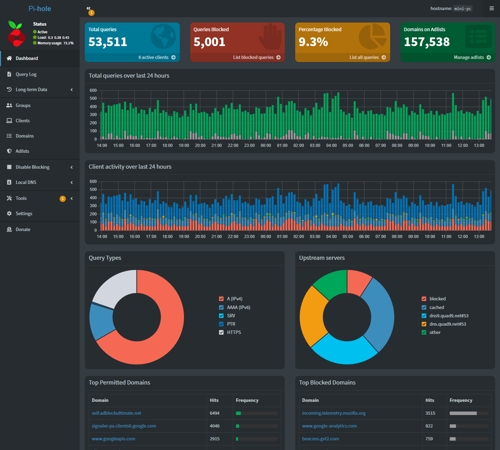
With pi-hole, for the most part, it's no longer necessary to install tools such as web browser Ad-Block add-ons because the pi-hole system has already blocked the domains that the Ad-Block add-on would otherwise block, by blocking them at a LAN's DNS entry point.
Upon first finding out about pi-hole while watching an episode of the computer tech channel Level1Techs on Youtube, Pi-Hole seemed like an excellent solution to the internet advertisers' worldwide war against internet users. During that first introduction from Wendell of Level1techs though, it seemed like deployment of pi-hole might be difficult. Later on, however, my brain's “I've got an idea” factory fired itself up with ideas to explore a different pi-hole deployment approach than the various options that Wendell of Level1techs had described in his various Youtube videos that contain information about the helpful beyond measure, open-source, community developed and maintained, Pi-Hole software application. Most of the options that Wendell has discussed involved using computer hardware such as Raspberry Pi computers or installing the software in the operating system in network attached storage (NAS) systems. Not being a fan of under powered Raspberry Pi computers and not having and using a separate NAS system, meant that it would useful to consider other computer hardware and operating system solutions that could deploy a PI-Hole on my local area network.
It seemed as though a feasibly cost effective way to deploy the Pi-Hole ad-blocking software package would be to purchase a type of tiny computer that Intel Corporation calls a Next Unit of Computing (NUC). Among various options, small NUC systems that incorporate AMD Ryzen laptop CPUs seemed to be the most viable option. The AMD Ryzen laptop CPU based NUCs provide the most computing power at each available price point. When amazon.com had its Amazon Prime Day on July 11, 2023, an ATOPNUC brand NUC containing an AMD Ryzen 3 3250U laptop CPU, plus 8GB RAM and a 256GB nvme SSD drive was on sale for $109.99 plus tax. It was “add to cart” at first sight. The just described ATOPNUC brand NUC is once again available on amazon.com, but not at the amazing sale price that it was available July 11, 2023.
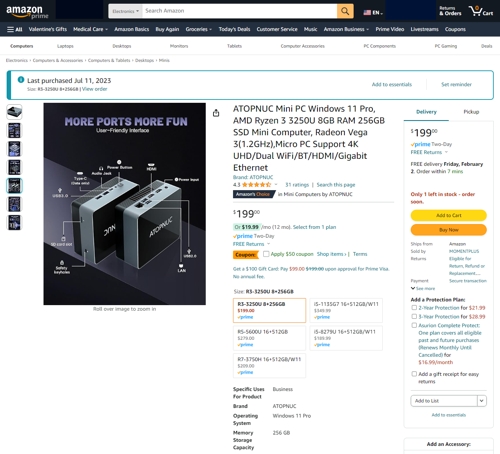
Meanwhile, delightfully, once amazon.com delivered the little ATOPNUC brand NUC, installing the Ubuntu Linux operating system on it, and then installing the PI-Hole Ad-Blocking software application on Linux, took less than an hour. The Pi-Hole installation instructions essential involve invoking a single command at the Linux bash command-line prompt. That's right, within an hour of hardware plug-in, it was possible to install Ubuntu Linux and then install and configure the Pi-Hole application, and have it controlling the DNS on my local area computer network. The Pi-Hole installation uses a Linux bash script that presents several configuration questions, after which its installation script does all the rest of its automated configuration work itself. The entire process was so surprisingly simple that it was a wonder it had taken so long to decide to set up Pi-Hole protection on my LAN to protect my computers from internet advertising intrusions.
The open-source, community developed, Pi-Hole software application now intervenes within the DNS pathway for the computers on my LAN, thereby blocking over 150,000 internet domains from being able to deliver malvertising to any of the computers on my personal LAN system. The three primary software scientists who invented, developed and maintain PI-Hole are: Dan Schaper; Adam Warner; and, Dominik Derigs. Having Pi-Hole firewalling my computers against internet advertising intrusion has been a computer technology universe revelation.
Thank you for visiting this website, my personal website, and enjoying the information and content shared here at www.marilynperry.com. Marilyn Perry